
Electrical · Fire · Security
EV Charger Installationin Newport, Caldicotand across Monmouthshire
A charger wired to the incoming supply properly, load-checked so it never trips the house, and commissioned before we leave, usually in a single visit.
16+ years’ experience · Free survey · Written quote within 7 days · Available 24 hours a day, 365 days a year
16+ years
hands-on electrical and solar experience
24/7, 365
available every day of the year
Free survey
written quote back within 7 days
Fully insured
owner-led work, tested and certificated
Reviewed locally
rated by customers across Monmouthshire
Home and workplace charging, installed correctly
A home charge point is the cheapest way to run an electric car, and the installation is the part that decides whether it stays that way. The charger itself is a commodity; the value lies in the supply assessment, the cable route, the earthing arrangement and the load management that stops your board tripping when the oven, shower and car all want power at once.
Most domestic installations are single-phase 7kW units, which replenish a typical battery overnight comfortably. Where a three-phase supply exists (workplaces, farms, units) faster charging becomes possible, and the design question moves to how many points the supply can carry simultaneously.
Pro-Detect surveys the property, checks the incoming supply and main earthing, agrees the charger position and cable route with you, and installs and commissions the unit. Because we are electricians first, any remedial work the installation needs is identified before the day rather than discovered on it.
Who it is for
- New EV owners replacing three-pin charging with a proper fixed unit.
- Households adding a second vehicle or a second charge point.
- Solar owners who want to charge on their own generation during the day.
- Workplaces, fleets and small commercial sites adding staff or visitor charging.
When it is needed
- A car on order or already on the drive with no fixed charge point.
- An existing charger that trips, faults or was never properly commissioned.
- Solar or battery storage going in, where charging should be integrated.
- A consumer unit with no spare capacity or no suitable protection for a charger.
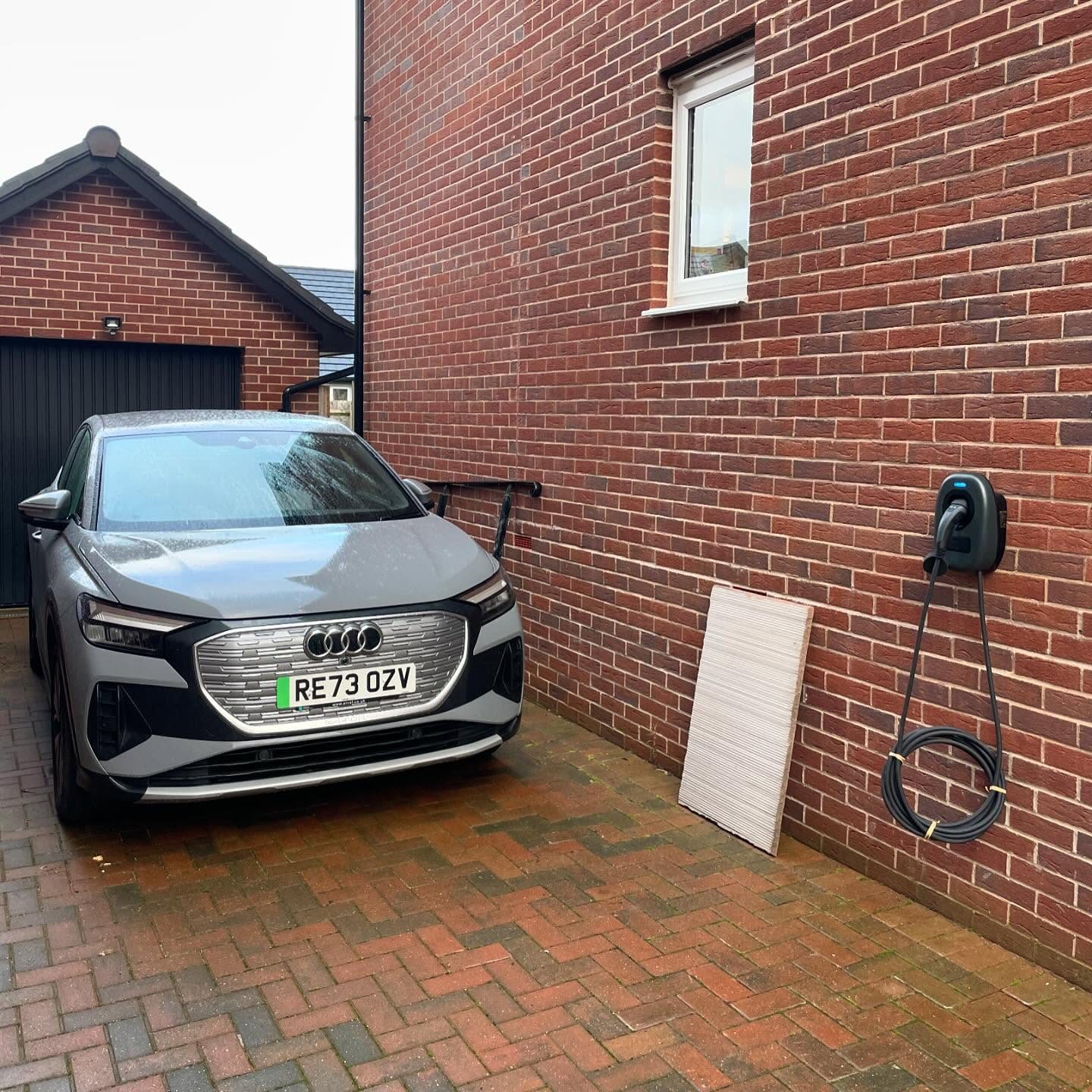
Recent ev charger installation work
Photographs from jobs we have completed, tested and handed over across Monmouthshire, Newport and Bristol.
See more of our workWhy a badly installed charge point causes trouble
An EV charger is one of the heaviest continuous loads a home will ever draw. Unlike a shower or a kettle it runs at close to full current for hours. Installations that would survive intermittent loads fail under that duty: warm terminations, degraded connections and repeated tripping.
The earthing arrangement is the safety-critical part. Outdoor charge points require specific protection against loss of the supply earth, and the correct approach depends on the earthing system at the property. Getting it wrong is not a performance issue; it is a shock risk on a metal car body outdoors.
Then there is capacity. Adding 32A of continuous load to a supply already close to its limit without load management causes the main fuse to operate, which is a supplier call-out, not a reset. Load-managed installations avoid this by throttling the charger when the rest of the house is busy.
Mistakes we see most often
- Running an EV long-term from a three-pin socket and extension lead.
- Fitting a charger without assessing the incoming supply and main fuse rating.
- Ignoring the earthing arrangement for an outdoor unit.
- Choosing a charger position that forces a long cable run across a driveway.
- Skipping load management on a supply that cannot take the extra current.
How the work runs, step by step
The same sequence every time, so you always know what happens next and who is doing it.
Free survey
Incoming supply, main fuse, earthing arrangement, board capacity, parking position and cable route are checked on site.
Specification and written quote
Charger, protection, any board work and cable route are set out in a written quote within 7 days.
Installation
Dedicated circuit, correct protective devices, secure cable containment and the unit mounted where you actually park.
Testing and commissioning
Circuit tested to BS 7671, protection verified, charger commissioned, connected to its app and charge scheduling configured.
Handover
You charge the car with us there, so you leave the installation knowing it works, not hoping it does.
What you get out of it
Overnight charging at home rates
A fixed 7kW point replenishes a typical battery overnight instead of over two days on a three-pin socket.
No nuisance tripping
Load assessment and, where needed, load management keep the charger and the rest of the house working together.
Correct outdoor protection
Earthing and protective devices specified for the actual arrangement at your property.
Solar integration
Where you have an array or battery, charging can be shifted to your own generation.
One visit where possible
Straightforward domestic installs are completed and commissioned in a single visit.
Electricians, not fitters
Board work, earthing upgrades and remedial electrical work are handled in-house.
EV Charger Installation in detail
Charger types, tethered and untethered
A tethered unit has the cable permanently attached: quicker to use daily, but you are committed to that connector type and cable length. An untethered socket unit takes your own cable, suits households with different vehicles and keeps the cable out of the weather between charges.
Smart charging functionality matters more than headline power on a domestic install. Scheduling, tariff integration, solar matching and remote control are what turn a charger into a cost-saving device rather than just a socket on a wall.
Supply capacity and load management
The survey establishes the main fuse rating, the existing maximum demand and how much headroom is genuinely available. Where the numbers are tight, a load-managed installation monitors the incoming supply and reduces charging current when household demand rises, then restores it afterwards.
This is invisible in day-to-day use (the car still charges overnight) but it prevents the main fuse operating, which is the failure mode that leaves you with no power at all until the network operator attends.
Earthing arrangements and outdoor safety
Charge points installed outdoors need protection against an open-circuit supply neutral, because a fault on the network can otherwise put the vehicle body at a dangerous potential. Depending on the earthing system present, that is addressed either by a charger with the protection built in or by a separate arrangement designed for the site.
Cable routes are run in armoured cable or suitable containment, terminations are weatherproofed, and the mounting position is chosen so the cable reaches the car's charge port without crossing a walkway.
Charging with solar and battery storage
If you have solar, daytime charging on surplus generation is the cheapest energy your car will ever take. Compatible chargers can be set to draw only from surplus, or to top up from the grid when a minimum charge is needed by morning.
With battery storage in the mix, priorities have to be set deliberately: house load first, then car, then battery, or another order that suits your pattern. We configure this at commissioning rather than leaving you to work it out from an app.
Workplace and multi-point installations
Workplace charging brings different constraints: several points sharing one supply, access control and usage recording, cable management across parking bays, and often a three-phase distribution board.
Dynamic load sharing lets a bank of chargers distribute available current across whichever vehicles are plugged in, so the site never exceeds its supply. Installation and switching can be scheduled outside trading hours because we work 24/7.
EV Charger Installation: your questions answered
How much does EV charger installation cost in Newport?
It depends on the charger, cable run, protection and whether board or earthing work is needed. The survey is free and a written quote follows within 7 days.
How long does the installation take?
Most domestic installations are completed and commissioned in a single visit. Longer cable runs, board upgrades or multi-point workplace installs take longer.
Can I charge from a normal socket instead?
Only slowly, and a three-pin socket is not designed for hours of near-continuous load. A dedicated circuit and fixed unit is both faster and safer.
Will a charger trip my fuse board?
Not when the supply is assessed properly. Where capacity is tight, load management reduces charging current while the house is busy.
Can the charger use my solar?
Yes, with a compatible unit. Surplus-only charging or a hybrid schedule can be configured at commissioning.
Which charger brand should I choose?
We specify to fit your parking arrangement, tariff, supply and whether you have solar, rather than pushing one brand at everyone.
Do you install chargers for businesses?
Yes: workplace and fleet installations, including multiple points with dynamic load sharing on three-phase supplies.
Can you replace or repair an existing charge point?
Yes. We take on faulty, poorly installed and end-of-life units, starting with testing the existing circuit.
How long does a charge point last?
Domestic units are long-service equipment; manufacturer warranty terms for the product specified are stated in your written quote.
Which areas do you cover?
Caldicot, Rogiet, Magor with Undy, Chepstow, Devauden and Catbrook, Monmouth, Abergavenny, Usk, Newport and Bristol.
Related services
Where we cover this work
Also covering Rogiet, Magor with Undy, Devauden & Catbrook, Usk and Bristol: see all service areas, read customer reviews or go back to the homepage.
Get ev charger installation priced properly: survey free, quote in 7 days
Llewys Saunders surveys the property, designs the work and installs it. One person accountable from the first call to the final test.
1 Ifton Avenue, Rogiet, NP26 3ST · Open 24 hours a day, 7 days a week, 365 days a year